Our History
On April 15, 1886 the Bellville Hook and Ladder Company1 was organized. E. Holtkamp was named the first president of the company. Arrangements were made for the purchase of a firefighting outfit. On April 24, 1886 addition officers were elected. The the first Foreman(Chief) was Gus Maetz. Incorporation charter was applied for under laws of the State of Texas. By the time the charter was received on October 19, 1889 the organization had been in existence more then three years.
Charter members of the Bellville Hook and Ladder Company No.1 were J. H. Machemehl, Willie Harloff, Julius Mittanck, Edw. Kastrop, F. W. Luhn, Will Washam, George Young, Fritz Westermann, Ben Grandville, E.O. Finn, Gus Kopisch, Henry Louwien, John Buelow, William Wennenweser, Colbert Glenn, Gus Louwien, Charles Wolf, Herman Hellmuth, Fritz Roensch, Will Heyne, Gus Maetze, Ed Jaeschke, and C. Schauerhammer.
On September 16, 1915, the Bellville Hook and Ladder Company No. 1 held a special meeting at the courthouse. Secretary of the organization, A. Meissner made a plea to local businessmen and citizens of Bellville concerning the problems confronting the fire company. The equipment in use was described as old, practically worn out and almost useless. The bell on the roof of the courthouse was out of order and in the event of a fire could not be sounded. The truck house, built in 1886 and moved in 1907 and was old dilapidated. In short, the fire company was now “very much crippled and inefficient.”
During the next year, steps were taken to correct several the problems. New housing for their apparatus was secured, and a motorized fire truck was purchased. Then on September 20 1916, a meeting was held by the Bellville Hook and Ladder Company No. 1. It was voted to reorganize and secure a new charter under the name of the Bellville Volunteer Fire Company. C. R. Johnson was elected President and William Willrodt was elected as Foreman (Chief).
Another major milestone was reached in the sping of 1928, when a new water system for the city was completed, Included in the system were 37 fire hydrants. The city government purchased 1000 feet of 2 1/2 inch fire hose in 50 foot lengths for the Bellville Volunteer Fire Company.
On May 4, 1928, th Bellville Times reported the first stream of water from the city’s well had been run through the mains the previous Monday. All fire plugs were thoroughly flushed, and “it seem the pressure will be tremendous”. Fire Cheif E. J. S. Pescke had the boys out Wednesday night for practice with the new fire hose and fire plugs in the city. This was the first time the firefighters ever had an opportunity to attach a hose to a real standard fire plug.
Following Gus Maetze as Foreman of Hook and Ladder Company were William Harloff, Colbert Glenn, William Willrodt and D. Dornberger. Beginning with William Willrodt on September 20, 1916, the head of the fire fighters was known as the chief. Willrodt was chief until April 16, 1919. He was followed by Ed Peschke, April 16,1919 to September 16, 1942; Joe a. Peschke, October 29, 1942 to January of 1971; Edger Steinbach, January of 1971, to December 31,1979, Warren Klump, January 1980, to December 31, 2008, when Anthony Rolater became Chief.
Sounding the fire alarm, the local newspaper frequently reminded its readers of the correct signals and the importance of giving them clearly “so you may know which way to run to reach the blaze.” The signal agreed upon was a single tap of the bell for a fire to the north of the courthouse, two taps for one to the east, three taps for south, and four taps for west. The same signals were used well into the nineteen hundreds, except that in the later years the bell sounded rapidly several times before giving the directional signal.
The coming of the telephone simplified the reporting of fire. In a newspaper of November 26, 1908, readers were reminded to “ring No.4 so correct signals may be given by the central alarm.” The bell at the top of the courthouse was in use, and A. C . Frank was in charge of ringing it once a call was received. Also, telephone operators would give necessary information regarding fires to any fireman who called.
The first siren used to sound fire alarms was installed in March of 1930. Switches for the siren were located in the telephone office, the fire house , and at the east side of the courthouse. Later in the 60’s the Plectron alert system was added to the alarm system. Each member had a unit in there home and were dispatched by the Austin County Sheriff Department dispatcher. The siren was still used to alert firefighters because if you were not at home you would not know when there was a call. The first fireman to the station would write the location of the call on the blackboard in the apparatus bay. In the 80’s the department went to personnel pagers for an alert system.
Information from Bellville Times by Isabel Frizzell

Our
Story
On April 15, 1886 the Bellville Hook and Ladder Company1 was organized. E. Holtkamp was named the first president of the company. Arrangements were made for the purchase of a firefighting outfit.
On April 24, 1886 addition officers were elected. The the first Foreman(Chief) was Gus Maetz. Incorporation charter was applied for under laws of the State of Texas. By the time the charter was received on October 19, 1889 the organization had been in existence more then three years.
Charter members of the Bellville Hook and Ladder Company No.1 were J. H. Machemehl, Willie Harloff, Julius Mittanck, Edw. Kastrop, F. W. Luhn, Will Washam, George Young, Fritz Westermann, Ben Grandville, E.O. Finn, Gus Kopisch, Henry Louwien, John Buelow, William Wennenweser, Colbert Glenn, Gus Louwien, Charles Wolf, Herman Hellmuth, Fritz Roensch, Will Heyne, Gus Maetze, Ed Jaeschke, and C. Schauerhammer.
On September 16, 1915, the Bellville Hook and Ladder Company No. 1 held a special meeting at the courthouse. Secretary of the organization, A. Meissner made a plea to local businessmen and citizens of Bellville concerning the problems confronting the fire company. The equipment in use was described as old, practically worn out and almost useless. The bell on the roof of the courthouse was out of order and in the event of a fire could not be sounded. The truck house, built in 1886 and moved in 1907 and was old dilapidated. In short, the fire company was now “very much crippled and inefficient.”
During the next year, steps were taken to correct several the problems. New housing for their apparatus was secured, and a motorized fire truck was purchased. Then on September 20 1916, a meeting was held by the Bellville Hook and Ladder Company No. 1. It was voted to reorganize and secure a new charter under the name of the Bellville Volunteer Fire Company. C. R. Johnson was elected President and William Willrodt was elected as Foreman(Chief).
Another major milestone was reached in the sping of 1928, when a new water system for the city was completed, Included in the system were 37 fire hydrants. The city government purchased 1000 feet of 2 1/2 inch fire hose in 50 foot lengths for the Bellville Volunteer Fire Company.
On May 4, 1928, th Bellville Times reported the first stream of water from the city’s well had been run through the mains the previous Monday. All fire plugs were thoroughly flushed, and “it seem the pressure will be tremendous”. Fire Cheif E. J. S. Pescke had the boys out Wednesday night for practice with the new fire hose and fire plugs in the city. This was the first time the firefighters ever had an opportunity to attach a hose to a real standard fire plug.
Following Gus Maetze as Foreman of Hook and Ladder Company were William Harloff, Colbert Glenn, William Willrodt and D. Dornberger. Beginning with William Willrodt on September 20, 1916, the head of the fire fighters was known as the chief. Willrodt was chief until April 16, 1919. He was followed by Ed Peschke, April 16,1919 to September 16, 1942; Joe a. Peschke, October 29, 1942 to January of 1971; Edger Steinbach, January of 1971, to December 31,1979, Warren Klump, January 1980, to December 31, 2008, when Anthony Rolater became Chief.
Sounding the fire alarm, the local newspaper frequently reminded its readers of the correct signals and the importance of giving them clearly “so you may know which way to run to reach the blaze.” The signal agreed upon was a single tap of the bell for a fire to the north of the courthouse, two taps for one to the east, three taps for south, and four taps for west. The same signals were used well into the nineteen hundreds, except that in the later years the bell sounded rapidly several times before giving the directional signal.
The coming of the telephone simplified the reporting of fire. In a newspaper of November 26, 1908, readers were reminded to “ring No.4 so correct signals may be given by the central alarm.” The bell at the top of the courthouse was in use, and A. C . Frank was in charge of ringing it once a call was received. Also, telephone operators would give necessary information regarding fires to any fireman who called.
The first siren used to sound fire alarms was installed in March of 1930. Switches for the siren were located in the telephone office, the fire house , and at the east side of the courthouse. Later in the 60’s the Plectron alert system was added to the alarm system. Each member had a unit in there home and were dispatched by the Austin County Sheriff Department dispatcher. The siren was still used to alert firefighters because if you were not at home you would not know when there was a call. The first fireman to the station would write the location of the call on the blackboard in the apparatus bay. In the 80’s the department went to personnel pagers for an alert system.
Information from Bellville Times by Isabel Frizzell


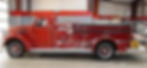
The Bellville Volunteer Fire Department has a long history. Engine 2 is a big part of that history. This 1947 International was built by Simms Fire Equipment Company San Antonio Texas. Engine 2 pumped at the Austin County courthouse fire in 1960, it was the newest piece of pumping equipment at the time. This is the second Engine purchased by the department. Engine 2 was restored by the Texas Department of Corrections in the 80’s and it still makes parades.
The first “fire Wagon” consisted of a hand-drawn vehicle equipped with six ladders, two long poles with hooks, two axes, two picks, twenty rubber buckets, and six large blankets, used to keep roofs near a fire from burning. This wagon had a tongue, and the men pulled it by a rope, which was on a windless. It was also equipped with oil lamps and a bell attached under the front axle. This bell was a alarm to warn people of the coming of the fire wagon, and rang from motion of the wagon. Later horses were used to pull the wagon.
In 1907 wheelwright E. O. Finn built a fire wagon with a 200 gal water tank and a four man hand pump this along with 50 feet of hose would provide a strong steam of water. It was necessary to keep the water tank full with a bucket line. In mid September of 1907 the fire department turned out in force to test the new apparatus. The stream from the hose easily ascended ten feet higher then any of the two story buildings on or adjacent to the square.
The fire company in 1916 purchased its first piece of motoized equipment, a chemical auto truck. The vehical was discribed in the local paper Augest 24, 1916, “The machine is equipped with two 30 gallon seamless drawn teel tanks with Victor seal acid receptacles. Each tank is equipped with pressure gauge, relief valve and dumping device, and connected to by pass valve and 2 1/2 inch hose connection, whereby one tank may be filled while the other is being discharged, or water may be forced through tank and hose, and furnish an efficient stream. It is also equipped with a 16 foot inside extension ladder, a crowbar and a fire axe.” The cost of the machine was $1500. and was necessary for the department to raise another $300 for shipping.
In 1923 a Ford model TT truck was purchased to be built into a new pump truck. A pump was mounted on the vehical and barrels of water were carried on the truck. Water would have to be taken out of the barrels with a bucket and poured into a reservoir for the pump.
When the first water mains where laid in 1928 it made a readily available water supply. water hose was needed as well as a truck to carry the hose. In 1931 the fire company purchased from F. W. Schurnburg, Inc., the local Ford dealer, a Model A Ford chassis for $609.25. this truck, which carried 1,000 feet of hose, along with the Model T pumper purchased in 1923, was the first really adequate fire protection the citizens of Bellville were to have.
The first modern pumper truck owned by the department was purchased by the city, and turned over to the department April 1, 1936. Designated Engine No. 1, this truck an International had a 300 gal. water tank.
Engine No. 2 was purchased in 1948 at a cost of $3355.50. Built on the International chassis.
In 1962, Engine 3 was purchased at a total cost of $16,101. Delivered October 3, 1962, was a 400 gallon pumper built on a Ford chassis, built by Simms Fire Equipment Company San Antonio, Texas. The need for purchase of this pumper grew critical when the state condemned the old Engine No. 1 purchased in 1936.
Engine 4, purchased in 1972, was built on a Ford chassis by Fire Fox fire Equipment Corp. It had a 750 gallon tank with a pump that delivered 750 gpm. This piece of equipment, costing 20,878.98, was paid for with the proceeds of the annual fund raisers.
Information from Bellville Times by Isabel Frizzell
Our Equipment Story
Station
History
HOUSING FOR THE FIRE COMPANY
On May 21, 1889, the Commissioners Court of Austin County gave permission to the newly organized Hook and Ladder Company No. 1 to erect a truck house on the part of the jail lot that was unfenced. This unfenced portion was the entire 120 feet of frontage on Holland street, running 66 feet back on Luhn Street. Within a month in time for the arrival of the company’s first piece of fire fighting equipment, a small building had been erected on the corner of Luhn and Holland. Funds for the construction were secured by public subscription. For the next twenty years the firemen were to store thier equipment at this site.
On April 28, 1900, for $200 Austin County sold to the fire company the north part of the unfenced property to the west of the jail, a lot north of the occupied by the 1886 truck house. This lot was out of the northwest corner of the jail property, running 52 feet along Holland and 66 feet deep. It was not until February of 1907 that the firemen moved their truck house to their own property immediately in front of the opera house.
August 10, 1913, the fire company evidently entered into a contract with C.A. Master, an active member of the fire company, permitting him to erect a galvanized iron building on the south 20 feet of the lot owned by the fire company, south of their small truck house. Master was to pay $15 a year rent.
In 1915, the truck house built in 1886 was described as “old and dilapidated.” The next year, this building was sold to Jesse Perrine and removed from the lot. In a contract dated August 4, 1916, the Bellville Hook and Ladder Company No. 1 agreed to permit C.A. Master to construct a 33X 65 foot galvanized iron building on fire company property, adjoining the one he had built 1913. This warehouse Master proposed to build would house his blacksmith and repair shop, as well as all fire fighting apparatus, which at the time included the old ladder wagon, hose truck and also a new chemical truck the firemen wanted to purchase. In this contract, the fire company agreed to pay the construction of a concrete floor and walls for the proposed building. Master further agreed to assume charge of the fire company’s equipment, keep same in good working order, make any and all repairs necessary, with the only charge to the fire company to be the cost of material.
On October 20, 1922, C.A. Master sold to Bellville Volunteer Fire Company for $800 the building and improvments he built on fire company property. This building was to hose the Firefighting equipment for the next 35 years. On January 15, 1930, it was voted to have the meeting hall made into a comfortable meeting place, and to permit Woodmen of the World, Sons of Herman, and Praetorian lodges to meet in the meeting roomat the rate of $20 per year. They were also to pay $6 per year toward the electric bill.
A bond issue in the amount of $75,000 was passed June 12, 1956, for the purpose of building a new fire station and city hall. Architect for the building was James K. Dunaway, grandson of C. Schauerhammer, one of the charter members of Bellville Hook and Ladder No. 1. The two story building located at the corner of Luhn Street and Holland Street (location of today’s city hall) was completed in 1957. The company’s regular meeting date was taken up with the business of moving from the 1916 galvanized iron building across the street to the new spacious quarters in the new station. Building dedication took place April 10, 1958, this was the home of the fire department until 1986.
In 1982 work on property donated by San Bernard Electric Co-Operative on West Main began, preparation for the building a new fire station along with fund raisers for the new station also began. Square footage in the proposed building was sold for $35 per foot, the fund raiser was met with enthusiastic response. The new station on West Main Street, completed in 1986, cost the department $360,166 to build.
Information from Bellville Times by Isabel Frizzell